Tuesday, December 30, 2008

Video Animation Intro and Flash Animation

Animation is the rapid display of a sequence of images of 2-D or 3-D artwork or model positions in order to create an illusion of movement. It is an optical illusion of motion due to the phenomenon of persistence of vision, and can be created and demonstrated in a number of ways. The most common method of presenting animation is as a motion picture or video program, although several other forms of presenting animation also exist.

http://upload.wikimedia.org/wikipedia/commons/a/a4/Animexample.gif

Early examples of attempts to capture the phenomenon of motion drawing can be found in paleolithic cave paintings, where animals are depicted with multiple legs in superimposed positions, clearly attempting to convey the perception of motion.

A 5,200 year old earthen bowl found in Iran in Shahr-i Sokhta has five images of a goat painted along the sides. This has been claimed to be an example of early animation. However, since no equipment existed to show the images in motion, such a series of images cannot be called animation in a true sense of the word.

The phenakistoscope, praxinoscope, as well as the common flip book were early popular animation devices invented during the 1800s, while a Chinese zoetrope-type device was invented already in 180 AD. These devices produced movement from sequential drawings using technological means, but animation did not really develop much further until the advent of cinematography.

There is no single person who can be considered the "creator" of the art of film animation, as there were several people doing several projects which could be considered various types of animation all around the same time.

Georges Méliès was a creator of special-effect films; he was generally one of the first people to use animation with his technique. He discovered a technique by accident which was to stop the camera rolling to change something in the scene, and then continue rolling the film. This idea was later known as stop-motion animation. Méliès discovered this technique accidentally when his camera broke down while shooting a bus driving by. When he had fixed the camera, a hearse happened to be passing by just as Méliès restarted rolling the film, his end result was that he had managed to make a bus transform into a hearse. This was just one of the great contributors to animation in the early years.
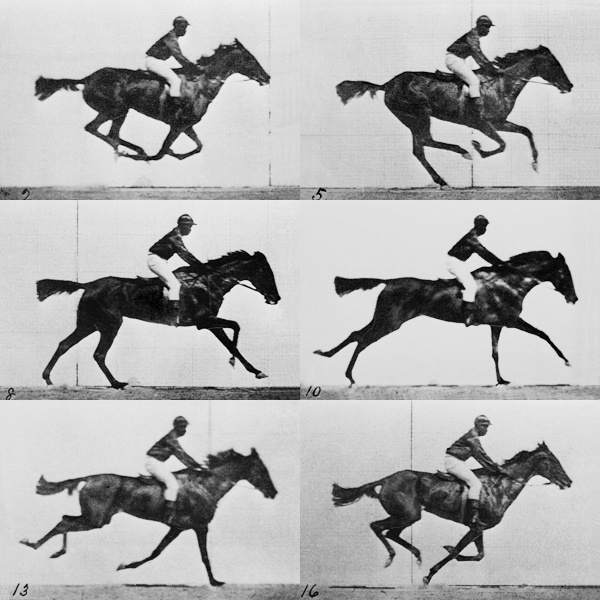
http://upload.wikimedia.org/wikipedia/commons/d/dd/Muybridge_race_horse_animated.gif

Flash Video Animation

Under the guidance of an award-winning, professional animator, you can learn the basic principles and fundamentals of Flash tools and techniques to create your own cartoons with great looking characters. Courses in drawing and animation are recorded as video lessons with assignments given afterwards to apply the knowledge you learn. As you build your skills, you'll be amazed at how your Flash animation improve

http://www.mehmetsaygin.com/blog/ths/ffp17.jpg

Animation Course

animation is well regarded for its high production quality. OVA titles generally have a much higher budget per episode than that of a TV series; therefore the technical quality of animation is almost always superior to TV series; occasionally even equal to that of animated movies.

OVA titles are also known for the detailed plots and character development which can result from greater creative freedom it offers to writers and directors than other formats. This also allows for animated adaptations of manga to be adapted more faithfully to the source material. Since OVA episodes and series can be any length, the director can use however much time he or she likes to tell the story. There is a great deal of time available for significant background and character/plot development. This is in contrast to TV episodes that must begin and conclude an episode in 22 minutes, or films which rarely last more than two hours. There is likewise no pressure to produce "filler content" to extend a short plot into a full TV series; OVA titles are generally targeted to a specific audience, rather than the more mass-market audience of films and TV series, and are not bound as much by content restrictions and censorship (such as violence, nudity, or language) that are often placed on television series.

http://www.cgexplorer.com/_sys/wp/wp-content/uploads/oktapodi-3d-animated-short-film.jpg

video animation

animation (anime) for animated films and series which are made specially to be released on home video formats. The majority are released direct-to-video, without prior showings on TV or in theatres, however, there may be very rare occasions where, for example, the first part of an OVA series is broadcast for promotional purposes. OVA titles were originally made available on VHS, later becoming more popular on LaserDisc and eventually

http://www.al4ie.com/images/axelfrog.jpg